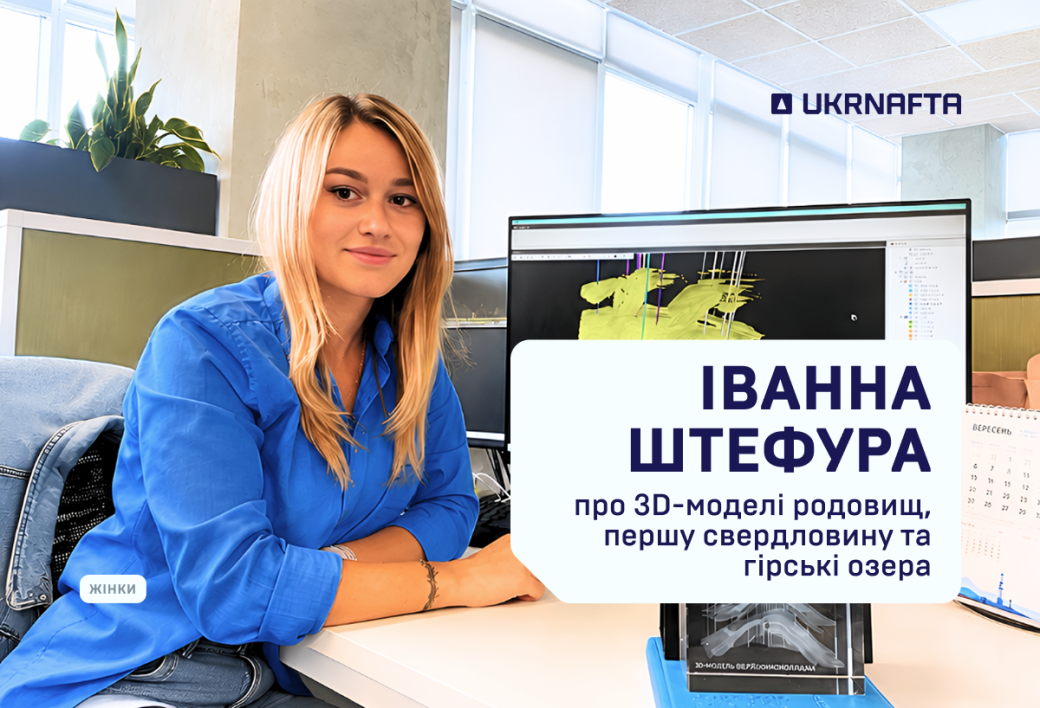
Ivanna Shtefura was born into a family of teachers in Transcarpathia. At first, her parents encouraged her to choose a similar path. But Ivanna immediately recognised that she wanted a dynamic career, new challenges and the ability to always learn something new. So, after Year 9, she entered the Drohobych College of Oil and Gas, and completed her studies at the Ivano-Frankivsk University, where she qualified as a geologist. Ivanna worked for a private company first. It was a flying start for the young specialist. Literally just a few days after defending her master’s thesis, she was already heading off on her first field trip to the Poltava region, to the Opishnia No. 101 well.
Later, Ivanna moved to Kharkiv and began working at the Ukrgasvydobuvannya Institute, in the 3D field modelling department. There, alongside seismologists, petrophysicists, geologists and reservoir engineers, she built 3D models of oil and gas fields. After the outbreak of full-scale war, Ivanna left Kharkiv for Ivano-Frankivsk. Then, in November 2022, she joined UKRNAFTA. She spotted the vacancy herself, filed her CV, passed an interview , and continued working in a field she already knew well - geological field modelling.
Today, her work involves 3D oil reservoir modelling, evaluating productive horizons, and issuing geological recommendations. Using these, the team can better understand the potential of the areas, plan further exploration, review new drilling spots, and seek solutions to enhance production. Some tasks require in-depth analysis, whilst others call for a rapid response. Sometimes an answer is needed within just a few hours: whether a specific horizon is worth considering, whether further studies make sense, and which geological risks or prospects shall be taken into account.
Ivanna likes that UKRNAFTA breaks her out of the rut. New fields, different areas, eastern and western regions, varying geological conditions. All of this means she delves into the subject, analyses and learns something new every single time. “The more I work, the more I learn. And that’s really great, because it means I am developing. And when recommendations make pan out and prove useful, that’s really satisfying. I feel like I am contributing to the bigger cause,” she says.
Outside of work, Ivanna doesn’t like to sit still either. She goes running, hiking, and enjoys a bit of ‘wild’ recreation – camping by the Dniester or hiking in the mountains with her husband and friends.
Svidovets, in the Drahobrat area, is her special place. Ivanna loves this part of the Carpathians because it hasn’t been overly altered by people yet. There are fewer cars, less development, and plenty of primeval mountain nature. One of her favourite ways to spend time there is to head to Drahobrat, spend the night in a tent by a wild lake, and set off in the morning for a full day’s hike along the ridge, crossing several mountains to see the high-altitude lakes.
The lake that impressed Ivanna most is Lake Vorozheska. Ivanna speaks of it with enthusiasm, but also with great caution. Places like this are easily damaged, so one shouldn’t swim in mountain lakes to avoid disrupting their ecosystem. “Places like this just carry your heart away,” she says.