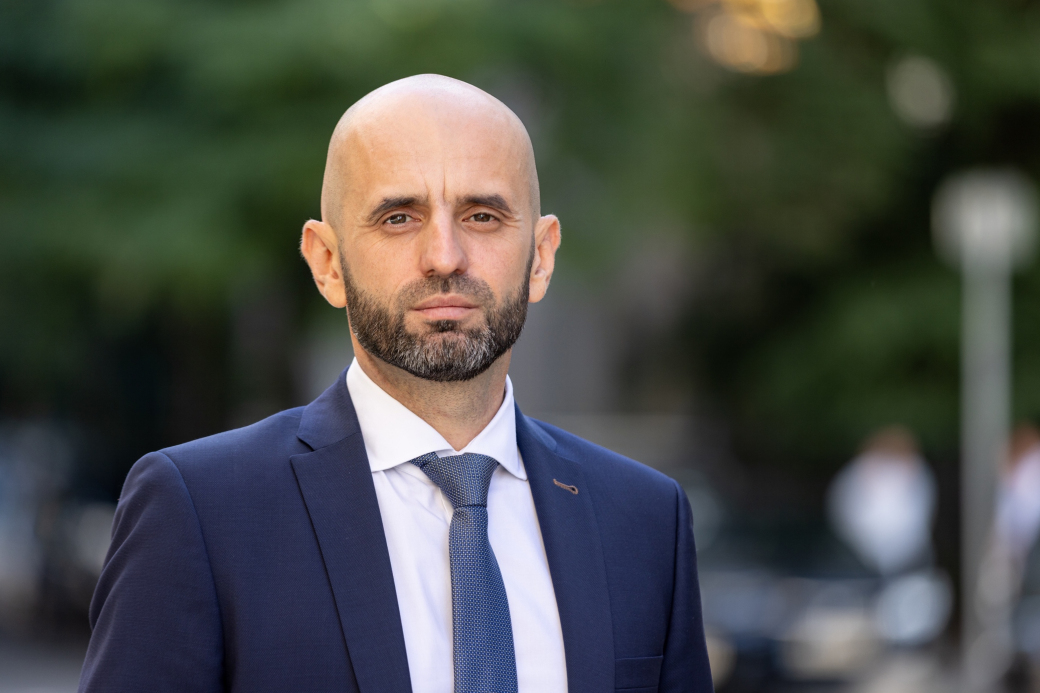
Exclusive interview with Bogdan Kukura, CEO of JSC Ukrnafta, for Interfax-Ukraine
Text: Dmytro Koshovyi, Nina Yavorska
– During the February–June crisis in the Middle East and the related disruption in the Strait of Hormuz, Ukrnafta played a role in containing fuel prices on the Ukrainian market. Now that the crisis has entered another phase, how do you assess the decision to keep prices lower?
– Since the start of the full-scale war, Ukrainians have had to adapt to a constant stream of new challenges and find the most effective ways to address them.
The decisions made by Ukrnafta, based on the Government’s recommendations on setting reasonable margins on petroleum products, have had a positive impact on the fuel situation in Ukraine.
People were able to obtain fuel at a fair price. Equally importantly, Ukrnafta ensured the availability of high-quality fuel in frontline regions, where it is critically needed by the people who live and work there. This also enabled us to expand our customer base and increase brand awareness for our network.
– Did you calculate how much the decision to contain prices cost the company?
– We will have a clear picture of our financial performance during this period at the end of the year, once we have the full financial results.
A preliminary calculation would unfortunately tell us very little because there are too many variables. In practice, each batch of fuel was purchased at a different price pegged to international quotes, which fluctuated constantly in response to developments in the Persian Gulf. In addition, half of our sales are wholesale volumes supplied under formula-based contracts and are therefore not linked to prices displayed on the price pylons at our filling stations.
We preserved our financial resilience while continuing to generate profit. At the same time, Ukrnafta fully honoured its commitments to both the public and the Ministry of Defence of Ukraine.
– We may face multiple subsequent waves of fuel price hikes. What will Ukrnafta’s market policy be going forward? Will you again seek to keep prices at the lower end of the market?
– Absolutely. As a state-owned company with a responsibility to the public and the country, we cannot maintain high price levels in situations like these.
At the same time, operating at a loss is out of the question. Our statutory objective is to generate returns for our shareholder — the State. We can achieve this through higher sales volumes, even with tighter margins.
Therefore, globally, we monitor the market and study our competitors, and look for competitively priced fuel on the market to sustain robust sales volumes. In other words, we are looking for the golden mean.
– The company stated it was aiming to boost fuel sales by around 20% this year. At the time, you likely did not anticipate a crisis of this scale in the Middle East. How is the plan progressing, and how is Ukrnafta currently performing in the market?
– Currently, according to independent market analysts, the UKRNAFTA network holds a leading position in fuel sales.
Of course, the position can change from month to month — we may rank first or second. But whereas previously we were probably around fourth place, we are now consistently among the top two. Our objective is to maintain that position through operational efficiency.
– Is your ambition to take the number-one position and hold it consistently?
– We have to be ambitious, particularly in such a competitive market. If you do not set ambitious goals, you will not survive. But what matters most is clear planning. That is what enables you to achieve the targets you have set.
– How do you assess the integration of the Shell, Glusco and U.GO filling stations into the UKRNAFTA network?
– The integration of these assets can now be considered complete. They are fully operational under the UKRNAFTA brand and have been seamlessly incorporated into the company’s unified operational, commercial and logistics processes.
Our focus today is not on further expanding the network, but on ensuring stable operations, protecting our facilities and maintaining uninterrupted fuel supplies.
The situation with the former Shell network is positive. Frankly, the results have even outperformed our expectations. We developed a dedicated blueprint to integrate the Shell stations into our network, and fuel sales volumes at these locations are now running ahead of our projections.
– What information do you have regarding the potential acquisition of a stake in Ukrnafta by Poland’s PKN Orlen?
– Ukrnafta is interested in attracting investors and potential partners.
First, we operate the largest filling station network in Ukraine. We have carried out extensive modernisation across a significant number of these sites, although a portion of the network still requires further upgrades.
We can clearly see the impact of this work. When modern filling stations with convenience stores open, the brand becomes more recognizable, offering a broader range of services, customers increasingly choose these locations. Ukrnafta has already demonstrated that it can operate filling stations to standards that are on par with other leading market players.
The second segment is production - Upstream. We hold 93 special permits. We are focusing our maximum activity on drilling operations to increase their production by approximately 40%. The remaining licences require substantial investment in exploration, appraisal and development. This is where an investor is needed.
If ORLEN is interested in Ukrnafta, it demonstrates that we are a transparent company capable of attracting a partner of this calibre. However, the pool of potential investors that may be interested in Ukrnafta is broader than ORLEN. The specific form of any future cooperation remains to be determined. We are open to partnership.
– As I understand it, mobile filling stations are not currently viewed as a priority alternative, but this remains an option that needs to be assessed and kept available if necessary?
– We need to understand all the implications of using mobile filling stations. First, there is a risk of creating a shadow-market segment, with unregulated operators appearing at different locations. This poses a risk primarily to consumers, because in the informal market the quality of the fuel could be highly questionable.
Second, legislative changes would be required for mobile filling stations to operate more broadly. Under the current regulations, a mobile filling station can only be used on the premises of an existing filling station and under its valid licence — for example, if the station itself has been destroyed. The security situation also needs to be taken into account, as this involves a fuel tanker operating in an area where people may gather.
Nevertheless, taking all these factors and risks into account, we must certainly be prepared to deploy mobile filling stations if necessary.
We already have several small-capacity fuel tankers of up to three cubic metres that can be used as mobile refuelling units, and we plan to purchase several more. We need to have this capability available so that we can respond quickly in times of need.
– What is the risk of fuel shortages amid the systematic destruction of filling stations, and what role does Ukrnafta play in preventing them?
– Damage to individual filling stations does not in itself mean there will be a fuel shortage. Ukraine’s fuel market has transformed significantly since 2022: supply sources have been diversified, logistics restructured, and new import routes integrated.
Today, the primary challenge is not the availability of fuel itself, but the ability to deliver it promptly to a specific region and ensure uninterrupted fuel dispensing even after infrastructure attacks. That is why we are enhancing our logistics capabilities, expanding our fleet of fuel tankers and maintaining a reserve of technical solutions to quickly restore operations at damaged filling stations.
– Based on the experience of your network, what are the initial results of the mandatory 7–10% bioethanol blending requirement introduced on 1 July this year?
– I would break this into two parts. The first is the supply side. The Ukrainian market heavily relies on A-95 petrol imports. Producers therefore need some time to ensure sufficient volumes are available, including an adequate supply buffer. At present, we also have to compete for these volumes with russian buyers, who are actively seeking to purchase fuel on international markets. This is creating some pressure on availability. At the same time, UKRNAFTA continues to operate steadily and is doing everything necessary to ensure reliable supplies for our customers.
The second aspect concerns consumer response. So far, we have not observed any significant change in customer behaviour. Our operations remain entirely stable, as before. The transition period is obviously ongoing, but at this stage we do not see any material risks in this area.
– How feasible is it to implement bioethanol blending in Ukraine under wartime conditions? Given that the original rationale for introducing bioethanol was to reduce petroleum product imports and support Ukrainian agricultural producers.
– If Ukrainian fuel producers could blend bioethanol into petrol domestically, it would be a perfectly viable approach. But everyone understands that Ukraine’s refining capacity has now been destroyed. We currently import pre-blended fuel.
– We know that russian strikes are also targeting production facilities. How are you managing to maintain production volumes — or even increase them, as you did last year?
– It is extremely challenging. Unlike filling stations, which have come under more frequent attack since May of this year, our production facilities have been targeted by strikes for over four years now.
I should also note that both the frequency and scale of these attacks on production facilities have grown. Unfortunately, the enemy’s strikes have also become more precise.
In the first half of 2026, our oil production losses were significantly higher than in the same period last year.
The second major challenge for oil production is the instability of power supply. The enemy continues to attack energy infrastructure heavily, and this affects our production facilities in eastern Ukraine.
Overall, our oil production is currently running slightly below target, but we are exerting every effort to maintain output levels. I would also like to thank our colleagues, who are restoring production as quickly as possible amid these challenging conditions.
Gas production, meanwhile, is running above target. Unlike oil production, it is less dependent on the power grid. At the same time, of course, the amount of equipment destroyed by attacks continues to rise.
– But presumably you are working to replace that equipment?
– Indeed, absolutely. We procure equipment using our own funds while also seeking donor assistance, including through international companies.
One of the main challenges of the existing Soviet-era equipment is its large footprint. Effective protection is either extremely difficult or cost-prohibitive. That is why we need new equipment featuring Level 2 protection (specifically designed to withstand direct drone strikes).
Everything within our own capabilities — the construction of protected underground storage tanks, pumping stations, and control rooms for personnel, alongside the reinforcement of existing above-ground assets — is being implemented to the fullest extent possible.
– How much support are you receiving from the Ukraine Energy Support Fund administered by the Energy Community Secretariat?
– Companies within Naftogaz Group have received a substantial amount of equipment through the Fund, generously provided by the governments of Norway, Sweden, Poland and other countries. In my view, the scale of this support is truly unprecedented.
Ukrnafta has received more than 50 diesel generator sets provided as humanitarian assistance. These are not standard generators, but high-capacity, megawatt-class equipment. Without this support, last winter would have been much more difficult for us.
– Can you specify the production losses caused by the damage?
– In terms of production, our oil losses over the first six months amounted to 150,000 tonnes. This figure encompasses both physical losses — oil destroyed as a direct result of the strikes — and production volumes lost due to operational shutdowns.
– Amid the ongoing war and continued attacks, what are your investment priorities today — production, development of the filling station network, or retail?
– The responsibility of any executive is to prioritise what actually works and delivers results. This is particularly critical during wartime. We are developing two core segments: upstream production and commercial operations.
Let me start with the commercial operations. We have suspended the UKRNAFTA network development programme in eastern Ukraine because continued attacks would effectively negate our modernisation efforts. Our priority there is protecting existing facilities. At the same time, we are pushing ahead with the modernisation programme in western Ukraine as extensively as possible, funded by the revenues generated by our commercial operations.
Overall, we aim to maintain a balanced approach to reinvesting the income generated by both segments — production and commercial operations.
– Last year, you set a company record by drilling 25 wells. What does the picture look like this year, given the significant increase in attacks?
– As I have said before, we have shifted our priorities towards facilities protection and equipment securing, including through underground construction. This year, we are allocating more than UAH 2.5 billion in additional funding to infrastructure protection – a truly substantial investment.
Accordingly, our target for this year is to deliver 15 wells completed by drilling. There is also a possibility that we will drill more, thanks to a balanced drilling programme.
In particular, cooperation between Ukrnafta and Ukrgasvydobuvannya has proven highly effective. Together with our sister Naftogaz Group company, we have already drilled three high-rate wells, each between 4.5 and 5.6 kilometres deep. This project has demonstrated the effectiveness of combining the expertise and capabilities of state-owned companies, and we plan to further develop this cooperation.
Overall, 11 wells have already been drilled since the beginning of the year, including those completed in partnership with Ukrgasvydobuvannya. For us, however, the sheer number of wells is not the primary measure of success. What matters most is economic efficiency, production rates and their contribution to increasing overall production.
– Which technologies are you betting on? We have been told that production is an area you are deeply passionate about and that you are constantly looking for new tools and mechanisms. How is Ukrnafta currently restructuring its operations in terms of production?
– Since transitioning to state management, Ukrnafta has delivered strong performance despite the war. We closely study the best practices of global industry leaders and integrate them across our operations.
Ukrnafta has adopted more than 100 American Petroleum Institute (API) standards. The Company also procures equipment from leading international manufacturers in Germany, the United States and Saudi Arabia, produced in accordance with API standards.
Take electric submersible pumps (ESPs) used in our oil wells as an example. Just two years ago, the mean time between overhauls (MTBO) for this type of equipment stood at 200 days, which is not particularly efficient by international benchmarks. Today, the company-wide average has reached approximately 500–600 days, while some equipment supplied by international manufacturers exceeds 700 days of continuous operations.
In other words, this equipment can operate for one or two years without requiring repair or replacement. Before the Company came under state management, much of the equipment in use was old russian or Soviet equipment. To put it simply, we replaced a Lada with a Mercedes — and performance improved dramatically.
– But it is also more expensive, isn't it?
– Absolutely. But the investment pays off. We originally set ourselves a target of 400 days, and we are now exceeding that by almost twofold. Compared with the previous average run life of 200 days, the improvement is more than threefold. That more than offsets the additional cost of purchasing modern equipment.
No matter how difficult the circumstances, we maintain strict adherence to standards and technical specifications, and we do not lower them. As the saying goes, if you buy cheap, you pay twice.
We are also working with leading international companies on automation initiatives. For example, together with Weatherford, we are deploying liquid chemical dosing systems. More than 100 programmable dosing units have been installed at wellheads across our fields, some of them powered by solar panels.
We are also introducing remote control systems for our pump jacks. We are fully automating their operation so that personnel can monitor and adjust operating parameters in real time, remotely.
The point is that we have no intention of moving away from international best practices and standards. I am pleased that our employees understand the value of these technologies and are becoming accustomed to working with high-quality equipment.
– Ukrnafta has become the first company in Ukraine to use wireless 3D seismic technology. What are the first practical results of these surveys, and where will new wells be drilled based on the 3D data obtained?
– In 2024-2025, we conducted 3D seismic surveys covering more than 1,210 square kilometres. Together with previous surveys, this work covered nine fields and two prospective areas. This represents approximately 10% of our total special permits. This is extremely important for the Company because it gives us a much clearer understanding of the subsurface — the geological formations, their structure and the depths at which they occur. Without this seismic data, it is very difficult to make informed decisions about further drilling.
Therefore, our objective is to sustain this momentum. For security reasons, we do not disclose the specific areas where surveys are being conducted or the locations of planned wells. However, I can confirm that 3D seismic has firmly established itself as one of our core tools for driving investment decisions in the exploration and development of our fields.
– Do you use contractors for this work, or have you developed the capability in-house?
– We do not have our own seismic equipment fleet or an in-house seismic services unit, so we engage external contractors.
– I remember following Ukrnafta back in the 1990s and early 2000s, when it was considered a blue-chip stock on the Ukrainian market. The Company had six oil and gas production divisions — three in western Ukraine and three in the east. At the time, virtually all the growth prospects were associated with the eastern divisions, while the western region's share had fallen to just over 20%. Now, during the war, the Company appears to be giving its western operations a second life. Is that driven purely by security considerations, or have these fields genuinely become attractive again? We have also seen reports of several transactions involving private operators in the region.
– There are several fields in western Ukraine where exploration and drilling have yielded impressive results, creating significant new opportunities for oil production.
For example, Ukrnafta previously significantly underestimated the potential of mountain fields. Today, we are successfully drilling wells on mountain ridges at elevations of more than 1,000 metres, and they are delivering strong performance. We are increasing production and building the necessary infrastructure, including pipelines and compressor stations. In practice, this has shown that these fields can be given a second life.
I would also highlight our reservoir pressure maintenance (RPM) projects, which represent a top development priority for Ukrnafta over the coming years. As hydrocarbons are produced, reservoir pressure naturally declines, severely impeding oil production. To counteract this, we deploy advanced waterflooding systems, injecting water back into the formation to replace produced fluids and significantly enhance sweep efficiency and oil recovery. Today, these measures maintain our current oil recovery factor at around 15%, and we expect to scale this to an ultimate recovery of 25–30% over time. Absent these vital pressure-maintenance projects, a significant portion of our fields would eventually cease to be economically viable.
– How interested are you in acquiring new licences, both in Ukraine and abroad?
– During the war, Ukraine is our priority. While we already hold a substantial portfolio of subsoil use permits, we are highly focused on expanding our resource base and stand ready to participate in auctions and acquire new E&P licences.
Everything we produce must be replaced by new resources. This is a standard practice for an upstream company and one of our key performance indicators: to continuously expand our resource base. There are two conventional ways to achieve this. The first is through 3D seismic surveys and other exploration work on existing fields to identify new reservoirs and horizons. The second is by acquiring new special permits.
Of course, the Ukrainian market is not particularly active in this respect at the moment, but we continue to monitor opportunities as new prospective fields and acreage become available.
– Can you give us a figure for the Company’s oil reserves? And perhaps gas reserves as well?
– 23 million tonnes. And, of course, through our 3D seismic surveys, we are working to replenish our reserves.
– Returning to attracting investors, how open is Ukrnafta to bringing partners into individual projects — for example, developing licences already in your portfolio or jointly bidding for new ones?
– The State provides a well-defined legal framework for securing investments through Production Sharing Agreements (PSAs). In my view, this remains the most effective mechanism for executing such strategic partnerships.
Are we prepared to pursue PSAs? Yes, absolutely. We need additional resources — financial resources as well as professional expertise and human capital — to work effectively across our existing portfolio of 93 subsoil use permits.
Therefore, we are prepared both to bring partners into projects and to participate ourselves in PSAs implemented in Ukraine.
– So, if the State were to revise the tender conditions for the Mezhyhirska and Svichanska blocks, which concluded unsuccessfully last year, could Ukrnafta bid for them alongside partners?
– We evaluate every project against strict economic viability criteria and base our decisions on these findings.
– How significant an opportunity could the U.S.-Ukraine Reconstruction Investment Fund be for Ukrnafta? I asked Sergii Koretskyi about this when he was still heading Naftogaz, and he said the Group had submitted several projects to the Fund.
– We are highly interested in strategic engagement with the Fund and have already submitted several commercial projects for evaluation. Should the Fund introduce co-investors looking to deploy capital alongside Ukrnafta, we are fully prepared to cooperate. Currently, we are in the active data-sharing phase: the Fund has been provisionally briefed on our core asset portfolio and licensed acreage, and joint efforts are underway to identify potential investors. The Fund is fully aware of our commitment, and we stand ready to evaluate proposals from prospective partners.
– Will Ukrnafta participate in the tender for 1.5 GW of new generation capacity announced by the Government? Unfortunately, the Company was unsuccessful in last year’s tender.
– We evaluate every opportunity. At the same time, irrespective of competitive tenders, we are maximizing our efforts to develop our own generation infrastructure. Specifically, Ukrnafta has signed an agreement with the European Bank for Reconstruction and Development (EBRD) for approximately EUR 45 million in donor assistance to build its own generation sites — 17 facilities with a combined capacity of roughly 63 MW.
Around 70–80% of this generation will be dedicated to ensuring the uninterrupted operation of our own facilities, while the remaining capacity is slated to supply electricity to the grid. We have already signed an agreement with the successful bidder for the supply of equipment, and work is expected to begin shortly. We plan to have part of the equipment delivered and installed this year.
Furthermore, in partnership with the EBRD, we are actively advancing the development of a 250 MW combined heat and power (CHP) plant to supply both electricity and thermal energy. Consultations on the project are currently underway.
– How is the process of completing the composition of the Company’s Management Board progressing?
– The Management Board is now fully constituted and operational. Anton Mishyn is responsible for finance, Vladyslav Voitenko for commercial operations, Oleh Malchyk for production, and Maris Kuniskis for ESG and power generation.
The Supervisory Board is not currently at full strength. The selection of a recruitment firm to identify candidates for the vacant independent member position is now nearing completion.
– Can we say that the Company has now transitioned from a sole executive to a collegiate management model?
– The Company’s Management Board has been functional since early January 2026, and we have been operating entirely within a collegiate corporate governance structure ever since. We strictly adhere to international best practices, incorporating regular Board meetings, robust reporting protocols, and close alignment with the Supervisory Board and shareholders.
– Under the new corporate governance structure, who decides on investment priorities?
– We have established an Investment Committee, an internal body that makes decisions on project implementation based on economic analysis. Take a drilling or reconstruction project, for example. What is its expected return? What value will it create for the Company? What are its NPV and IRR? By comparing these metrics across different projects, the Company makes its final investment decisions.
The system works very effectively. Before joining Ukrnafta, I spent the previous 15 years working for various private-sector companies. Based on that experience, I can say that the quality of project evaluation at Ukrnafta is in line with leading international and Ukrainian practices. Some colleagues who joined us from private companies did not expect a state-owned company to have processes of this standard.
At Ukrnafta, every project undergoes detailed financial and economic analysis, followed by post-implementation monitoring to determine whether the actual results match the projected solutions. Everything is handled very pragmatically.
– For a long time, the Company was led by top managers with backgrounds primarily in finance or retail. What are the main advantages of having an engineer with an operational background leading the country’s largest oil company during a period of technological modernisation?
– Let me start with a broader point, something I have understood through experience. To manage a company effectively, you need to have logical thinking, knowledge, the drive to move forward, develop, perceive, listen, and pay attention to others. If a person has all of this, the absence of a highly specialised education or a specific professional background does not affect the quality of work.
As for Ukrnafta specifically, we have Management Board members who are professionals responsible for their respective areas. We have an experienced management team. We have a Supervisory Board that provides strategic oversight and governance. And we have specialised committees, including the Investment Committee. Major decisions are made collectively, following a joint assessment of the available options.
– You are the author of several patents related to oil and gas production. To what extent are they currently used by the Company?
– There are two main types of patents: patents for inventions and patents for utility models. My patents are related to utility models. My goal was not financial gain; I was simply interested in patenting my own developments.
Therefore, yes, I have more than a dozen patents. Ukrnafta and other companies use the solutions covered by them, and everything works exceptionally well, because these patents are widely accessible.