Oksana Yarmak was born and raised in a small village in the Poltava region. Her family expected her to become a teacher: her mother worked in education, and the girl herself got on well with children, was active at school, and achieved excellent academic results. But she chose a different path for herself.
“Everyone told me: you ought to be a teacher." And I understood that I did not want to. I wanted to try something else,” she recalls.
Thus, Oksana enrolled at the Poltava National Technical University named after Yuri Kondratyuk, specialising in industrial and civil engineering. At the time, it was a practical choice that offered the opportunity to study for free, obtain a technical education, and acquire a solid profession.
The first years of study were challenging. The specialty required a lot of precision, technical thinking, and endurance. However, when the specialised subjects began, Oksana gradually got engaged. After graduating from university, she no longer considered options for working outside her field.
“I invested five years of study into this. I did not want to just go somewhere where this education would not be used. I decided that I needed to see this path through to the end,” says Oksana.
Her first job was at the Poltava regional clinical hospital. Oksana started as an engineer on a minimum salary, without much experience, but with a strong willingness to learn and take responsibility. Her scope of work involved repairs, the technical condition of buildings, and engineering systems. She supervised plumbers, painters, and carpenters - a predominantly male team with their own experience, habits, and character. At first, they kept a close eye on the young engineer, evaluating whether she understood the processes, could make decisions, and was not afraid to take responsibility.
Over time, their attitude changed. When her colleagues saw that Oksana knew her stuff, spoke to the point, and did not pass complex issues on to others, they began to treat her as a true professional.
After two years at the hospital, feeling the need for professional growth, she moved to a structural unit of the Poltava regional state administration. There, she progressed from a leading specialist to the head of the technical supervision department.
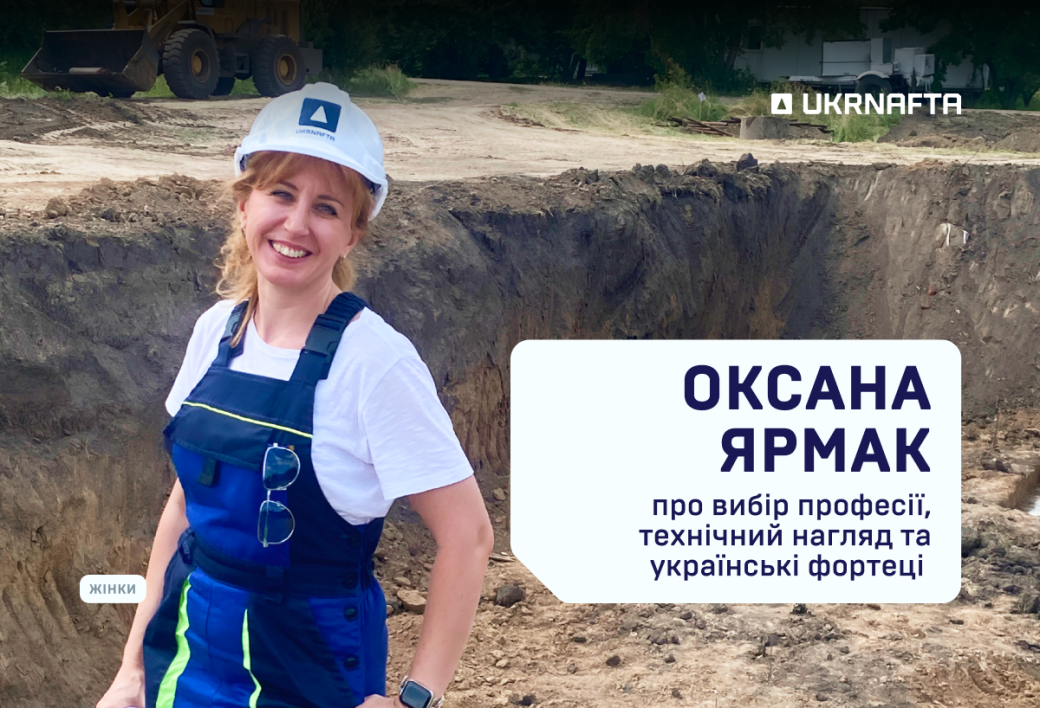
Oksana joined the Ukrnafta team in 2024. Today, she works as a leading engineer in the capital construction group in Poltava.
The transition from civil construction to the oil and gas industry marked a new professional milestone for her. Today, she provides technical supervision for construction and work quality, liaises with contractors, and oversees repairs and capital works. Her tasks is to ensure that facilities meet all requirements, are safe for people, and reliable in operation.
“Switching from civil construction to the oil and gas industry opened up new professional challenges for me due to stricter technological standards and safety requirements. I love my job for its visible results. On the one hand, it is repairing facilities and improving the daily lives of my colleagues; on the other, it is launching new facilities that boost the efficiency of the entire production,” she shares.
Outside of work, Oksana travels extensively. For her, it is a way to recover from the workload, switch gears, and simultaneously feed her professional curiosity. She enjoys short weekend trips, often travelling with friends and discovering Ukraine.
She is particularly drawn to places where she can observe scale, construction techniques, engineering thought, and materials. Oksana looks at fortresses, castles, and old structures not just as a tourist, but as a builder: she pays attention to how the bricks are laid, how the walls hold up, how the space is organized, and how the structure has survived the test of time.
Among the places that left a strong impression on her is the Tarakaniv Fort in the Rivne region. For Oksana, it is not just a tourist spot, but a powerful engineering marvel with underground spaces, immense scale, and a unique atmosphere. She also mentions Lutsk castle and Khotyn fortress – places where history is literally held in stone.
A special love – Opishnia in Poltava region. She advises visiting not just for an hour, but for at least a full day: to explore the museums, attend pottery master classes, visit the local artels, and feel how craftsmanship can be part of a living culture. She particularly mentions the local cuisine – specifically borscht with smoked pear at the 'Staryi Khutir' estate.